Sunday, October 28, 2012


Micro-Drones Combined With DNA Hacking Could Create A Very Scary Future
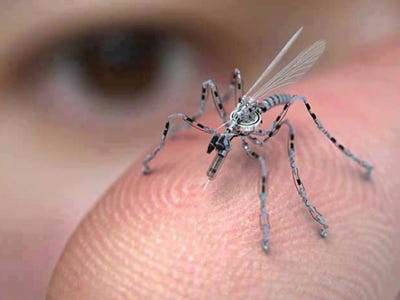
Sightings of insect-sized micro drones have been occurring for years, but combined with the direction of genome sequencing outlined in this Atlantic piece — the pair make for a futuristic and potentially deadly mix.
Even back in 2007, when Vanessa Alarcon was a college student attending an anti-war protest in Washington, D.C. she heard someone shout, "Oh my God, look at those."
"I look up and I'm like, 'What the hell is that?'" she told The Washington Post. "They looked like dragonflies or little helicopters. But I mean, those are not insects," she continued.
A lawyer there at the time confirmed they looked like dragonflies, but that they "definitely weren't insects".
And he's probably right. In 2006 Flight International reported that the CIA had been developing micro UAVs as far back as the 1970s and had a mock-up in its Langley headquarters since 2003.
While we can go on listing roachbots, swarming nano drones, and synchronized MIT robots — private trader and former software engineer Alan Lovejoy points out that the future of nano drones could become even more unsettling.
 Lovejoy says "Such a device could be controlled from a great distance and is equipped with a camera, microphone. It could land on you and then use its needle to take a DNA sample."
Assuming all that to be possible, the Atlantic paints a complimentary scenario.
Authors Andrew Hessel, Marc Goodman, and Steven Kotler outline futuristic human genome work that evolves from the very real GE $100 million breast cancer challenge.
In the group's scenario a bunch of brilliant freelancers receive bids to design personalized virus' offering customized cures for the sick.
Say you get pancreatic cancer, instead of chemo' — the first step in treatment will be decoding your genome — which costs about $1,000 right now and takes a couple of days.
An eternity when you're rife with cancer, no doubt, but a far cry from the two years and $300 million it required less than a decade-and-a-half ago.
But imagine, the three writers ask: it's 2015, and with information about the disease and your exclusive genome sequence, tomorrow's virologists will have only a simple design problem on their hands.
The problem will be freelanced out for bids, like a brochure design on Elance, and the winning design will be a formula that'll rid your body of the cancer.
All of this is pretty plausible, if not a bit short on the timeline, but imagine the request for proposal of your pancreatic cancer cure was something else.
 Imagine it was the genome of a particular African leader recruiting children to fight his wars, and that his DNA had been high-jacked in 2009 at the UN by order of Hillary Clinton.
Same scenario applies. The request for a drug tailored to that particular genome is accepted. It's paid for and forwarded to an online bio-marketplace, which sends it to a synthesis start-up that turns "the 5,984 base-pair blueprint into actual genetic material."
Here the future of drones and virology could intersect.
A few days later tablets are delivered to a group that dissolves them and injects the liquid into a handful of micro-drones. The team releases the drones and infects the people in the African leader's circle of advisors or family.
The infected come down with flu like symptoms, coughs and sneezes that release billions of harmless virus particles — but when they bring their symptoms in the vicinity of the African leader — the particles change.
Once the virus particles are exposed to that very specific DNA sequence, a secondary function within their design unlocks. In the Atlantic piece the target is the U.S. president via sneezing Harvard students, but the effect would be the same. In that case it was a "fast-acting neuro-destructive disease that produced memory loss and, eventually, death."
Same for the African leader, though the symptoms could be tailored an infinite number of ways. Designed to reflect a uniquely local affliction like Dengue Fever, or to appear like symptoms of a genetic condition.
The drone and bio-technologies are approaching the point where something like this is theoretically possible, even if for now, it's only imagination.
Renewable Energy: The Vision And A Dose Of Reality

In recent years, there has been more and more talk of a transition to renewable energy on the grounds of climate change, and an increasing range of public policies designed to move in this direction. Not only do advocates envisage, and suggest to custodians of the public purse, a future of 100% renewable energy, but they suggest that this can be achieved very rapidly, in perhaps a decade or two, if sufficient political will can be summoned. See for instance this 2009 Plan to Power 100 Percent of the Planet with Renewables:
A year ago former vice president Al Gore threw down a gauntlet: to repower America with 100 percent carbon-free electricity within 10 years. As the two of us started to evaluate the feasibility of such a change, we took on an even larger challenge: to determine how 100 percent of the world’s energy, for all purposes, could be supplied by wind, water and solar resources, by as early as 2030.
See also, as an example, the Zero Carbon Australia Stationary Energy Plan proposed by Beyond Zero Emissions:
The world stands on the precipice of significant change. Climate scientists predict severe impacts from even the lowest estimates of global warming. Atmospheric CO2 already exceeds safe levels. A rational response to the problem demands a rapid shift to a zero-fossil-fuel, zero-emissions future. The Zero Carbon Australia 2020 Stationary Energy Plan (the ZCA 2020 Plan) outlines a technically feasible and economically attractive way for Australia to transition to a 100% renewable energy within ten years. Social and political leadership are now required in order for the transition to begin.
Read more: The Automatic Earth
Saturday, October 27, 2012
Man Buys 1 Million Facebook Users’ Personal Information for $5
How much is your personal information worth? How about a data set consisting of over 1 million individual’s personal information complete with their full legal name, personal E-mail address, and URL to their Facebook account as confirmation?
According to one ‘mystery’ company that recently sold 1 million Facebook users’ personal information to a very surprised blogger, not very much at all. About $5, to be specific.
It all started when one blogger, a self-proclaimed seeker of ‘cheap’ deals that pertain to potentially useful or interesting subjects, stumbled across an offer for ’1 million Facebook accounts’ for $5. Skeptical but willing to try it out, the blogger purchased the list to be met with much surprise when he actually personally identified many of the users on the list to be people he actually knew personally. Complete with their personal E-mail address (which Facebook is supposed to keep ‘hidden’), full names, and a link to their page to verify, this blogger had stumbled across a major corporation’s dream come true.
According to the description from the seller of the list, the information was collected through Facebook applications and even checked monthly to ensure validity. The description stated:
The information in this list has been collected through our Facebook apps and consists only of active Facebook users, mostly from the US, Canada, UK and Europe… The list is checked and validated once a month so you won’t get a list full of invalid or duplicate email addresses… this list has a great potential for you.
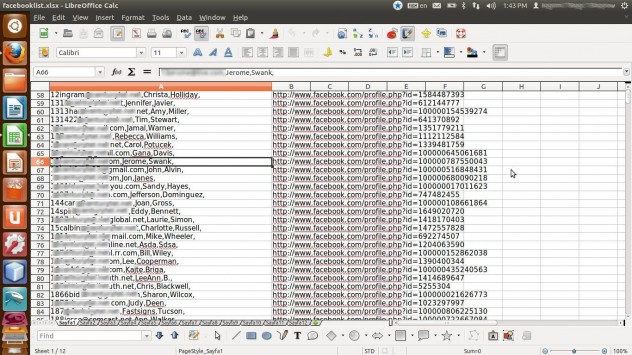
After purchasing the list and being amazed at its legitimacy, the IT blogger posted an entry detailing the event along with screenshots and a surprising follow-up. Using his personal E-mail provided when signing up for his Facebook account, Facebook’s ‘policy’ team member sent him an E-mail asking him to set up a call with the company. During the call, things got very concerning.
Facebook Rep: Send Us the File, Delete it, And Tell No One
Starting off with a warning to the blogger that the phone call was being recorded, the unnamed Facebook rep told the blogger to send them the file of the 1 million users’ information, delete it, and delete all traces of its mentioning off of his blog.
Not agreeing to censor the information, the blogger posted the quote from the phone conversation on his website:
Now we would like you to send us this file, delete it, tell us if you have given a copy of it to someone, give us the website from which you bought it including all transactions with it and the payment system and remove a couple of things from your blog. Oh and by the way, you are not allowed to disclose any part of this conversation; it is a secret that we are even having this conversation.Proceeding to ask whether or not the rep would fill him in on what would be done by the company, the rep said that it was an internal issue and that he would not be allowed to know the result.
It has been known for years that Facebook’s very own terms of service allows for blatant privacy intrusions, and the company has been even caught syncing up with major third party corporations to track you online and offline. What has not been seen, however, is an event of this caliber taking place involving the average consumer. No longer are the days where major corporations were forced to buy your personal information and habits through terms of service changes and large volumes of cash.
Now, almost anyone can go online and buy 1 million E-mails, names, and Facebook URLs for a total of $5. In other words, you could purchase tens of millions of E-mails to spam or otherwise for a very inexpensive amount. What’s more is that criminals could also purchase this database for further malicious reasons. It’s no wonder that Facebook refuses to discuss the matter in any capacity, demanding that the blogger remove all content on the subject and pretend that it never happened.
If you absolutely cannot delete your Facebook, you can at least stop using apps on the platform that are known to be siphoning your personal information. Also be sure to use a Facebook specific ‘dummy’ E-mail when signing up and choose a nickname or alternative name that is not the same as your full legal name.
Source: Activist Post
Friday, October 26, 2012
Berlusconi Sentenced to Four Years in Prison for Fraud
It is unlikely that Berlusconi will serve any jail time given his age, 76, and the Italian appeals process, which can run out the statute of limitations. The court pardoned three years of the sentence. He was also barred from public office for five years, according to a sentence read today by a judge in Milan.

Silvio Berlusconi, Italy's prime minister, pauses during a news conference following the Group of 20 (G20) Cannes Summit in this file photo. Photographer: Chris Ratcliffe/Bloomberg

Oct. 26 (Bloomberg) -- Silvio Berlusconi, the billionaire former Italian prime minister, was found guilty of tax fraud and sentenced to four years in prison in a film-rights case involving his Mediaset SpA television company. Berlusconi's sentence was read today by a judge in Milan. Sara Eisen and Erik Schatzker report on Bloomberg Television's "Market Makers." (Source: Bloomberg)


Oct. 26 (Bloomberg) -- Former Italian Prime Minister Silvio Berlusconi, who describes himself as the persecuted man in history, was found guilty of tax fraud and sentenced to four years in prison in a film-rights case involving his Mediaset SpA television company. Sara Eisen reports on Bloomberg Television's "Market Makers." (Source: Bloomberg)
“He won’t go to jail because criminal sentences in the first instance aren’t executed if an appeal is presented within 15 days,” said Fabio Belloni, a criminal lawyer who previously defended Parmalat (PLT) Chairman Calisto Tanzi in Italy’s biggest bankruptcy case.
“‘The sentence remains suspended until the end of the appeals process. The same thing with the ban from public office,” he said.
The ruling came in the same week that the three-time prime minister announced that he would not run for the premiership in elections due by May. Berlusconi has accused prosecutors of trying to destroy him politically and has said that he has spent more than 400 million euros ($517 million) on his legal defense in more than a dozen corruption trials since he entered politics in 1994.
Mediaset Declines
Shares in Mediaset SpA, Berlusconi’s media company at the center of the case, fell 2.8 percent to 1.34 euros. That compared with an advance of 0.2 percent in Italy’s benchmark FTSE MIB index.
“The sentence confirms years of judicial persecution,” Paolo Bonaiuti, Berlusconi’s, spokesman said in an e-mailed statement.
Berlusconi’s lawyers, Niccolo Ghedini and Piero Longo, called the verdict “absolutely incredible” and “lacking legal logic,” in an e-mailed statement. They plan to file an appeal of the decision, and said “they trust” that a higher court will overturn the verdict. Berlusconi can appeal the verdict two more times under Italian law.
The ruling comes as Berlusconi faces another trial on charges of paying for sex with a minor. The revelations about his relationship with a 17-year-old Milan nightclub dancer and the so-called Bunga Bunga parties he threw at his Milan residence led to a slump in his popularity last year that contributed to his resignation as prime minister in November.
The charges in the Mediaset case stem from before Berlusconi entered politics, when he was still actively managing the media company that he founded. Fedele Confalonieri, chairman of Mediaset and a co-defendant in the trial, was absolved by the court.