


The technology at the heart of the Supercharger was developed internally and leverages the economies of scale of existing charging technology already used by the Model S, enabling Tesla to create the Supercharger device at minimal cost. The electricity used by the Supercharger comes from a solar carport system provided by SolarCity, which results in almost zero marginal energy cost after installation. Combining these two factors, Tesla is able to provide Model S owners1 free long distance travel indefinitely.
Each solar power system is designed to generate more energy from the sun over the course of a year than is consumed by Tesla vehicles using the Supercharger. This results in a slight net positive transfer of sunlight generated power back to the electricity grid. In addition to lowering the cost of electricity, this addresses a commonly held misunderstanding that charging an electric car simply pushes carbon emissions to the power plant. The Supercharger system will always generate more power from sunlight than Model S customers use for driving. By adding even a small solar system at their home, electric car owners can extend this same principle to local city driving too.
The six California locations unveiled today are just the beginning. By next year, we plan to install Superchargers in high traffic corridors across the continental United States, enabling fast, purely electric travel from Vancouver to San Diego, Miami to Montreal and Los Angeles to New York. Tesla will also begin installing Superchargers in Europe and Asia in the second half of 2013.
The Supercharger is substantially more powerful than any charging technology to date, providing almost 100 kilowatts of power to the Model S, with the potential to go as high as 120 kilowatts in the future. This can replenish three hours of driving at 60 mph in about half an hour, which is the convenience inflection point for travelers at a highway rest stop. Most people who begin a road trip at 9:00 a.m. would normally stop by noon to have lunch, refresh and pick up a coffee or soda for the road, all of which takes about 30 minutes.
"Tesla's Supercharger network is a game changer for electric vehicles, providing long distance travel that has a level of convenience equivalent to gasoline cars for all practical purposes. However, by making electric long distance travel at no cost, an impossibility for gasoline cars, Tesla is demonstrating just how fundamentally better electric transport can be," said Elon Musk, Tesla Motors co-founder and CEO. "We are giving Model S the ability to drive almost anywhere for free on pure sunlight."
About Model S
With the most energy-dense battery pack in the industry and best-in-class aerodynamics, Model S has the longest range of any production electric car in the world. Model S comes with three battery options to fit the unique needs of different drivers. The 85 kWh Model S has received a U.S. fuel economy rating of 89MPGe and an EPA rated range of 265 miles.
Model S is the first premium sedan designed from the ground up to take full advantage of electric vehicle architecture. A revolutionary powertrain sits under the floorboard of Model S, creating an ultra-low center of gravity. Paired with an aluminum body engineered for superior handling, Tesla has created a vehicle that raises the bar for performance and efficiency while meeting the highest standards for safety.
Without an internal combustion engine or transmission tunnel, the interior of Model S has more cargo space than any other sedan in its class and includes a second trunk under the hood. Model S seats five adults and two children in optional rear-facing child seats. Model S Performance models accelerate from 0 to 60 mph in under 4.4 seconds. The interior features a 17" in-dash touchscreen with internet capabilities, allowing for streaming radio, web browsing and navigation.
Customers can reserve a Model S at one of Tesla's retail stores or online.
About Tesla
Tesla's goal is to accelerate the world's transition to electric mobility. Palo Alto, California-based Tesla designs and manufactures EVs and EV power train components for partners such as Toyota and Daimler. Tesla has delivered more than 2,350 Roadsters to customers worldwide. Model S, the first premium sedan to be built from the ground up as an electric vehicle, began deliveries in June 2012.
Interested in keeping up with Tesla Motors?
For more information on Tesla Motors and its products, please visit: teslamotors.com
For more information for Tesla Motors investors, please visit: ir.teslamotors.com
For the latest information from Tesla Motors, including press releases and the Tesla blog, please visit: teslamotors.com/press
Forward-Looking Statements
Certain statements in this press release including statements regarding future Supercharger locations and capabilities are "forward-looking statements" that are subject to risks and uncertainties. These forward-looking statements are based on management's current expectations. Various important factors could cause actual results to differ materially, including the risks identified in our SEC filings. Tesla disclaims any obligation to update this information.
1 Supercharging hardware is standard on Model S vehicles equipped with an 85 kWh battery and optional on Model S vehicles equipped with a 60 kWh battery.
By Sean Poulter
Russia has suspended the import and use of an American GM corn following a study suggesting a link to breast cancer and organ damage.
Separately, the European Food Safety Authority(EFSA), has ordered its own review in to the research, which was conducted at a French university.
The decision by Russia could be followed by other nations in what would be a severe blow to the take-up of the controversial technology.
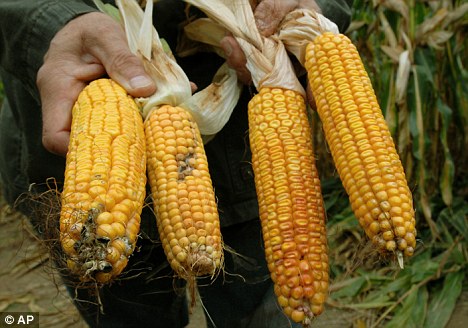
Cancer risk? A farmer shows two corncobs of genetically engineered corn by U.S. company Monsanto, right, and two normal corncobs from Germany, left
Historically, biotech companies have proved the safety of GM crops based on trials involving feeding rats for a period of 90 days.
However, experts at the University of Caen conducted an experiment running for the full lives of rats - two years.
The findings, which were peer reviewed by independent experts before being published in a respected scientific journal, found raised levels of breast cancer, liver and kidney damage.
The same trials also found evidence that consumption of minuscule amounts of a commonly used weedkiller, Roundup, was associated with a raised risk of cancer.
Both the GM corn, which carries the name NK603, and Roundup are the creation of US biotech company Monsanto.
The decision by the Russians to suspend authorisation for the American GM corn threatens to trigger a transatlantic commercial and diplomatic row.
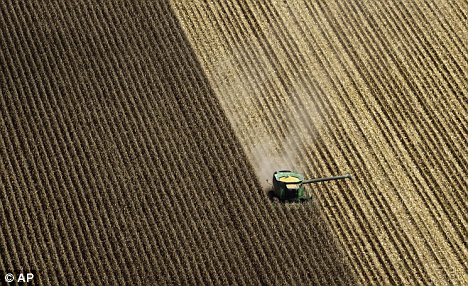
Contentious: A combine harvests corn in a field near Coy, Arkansas. The decision by the Russians to suspend authorisation for the American GM corn threatens to trigger a transatlantic commercial and diplomatic row
Russia’s consumer rights watchdog, Rospotrebnadzor, said today that it has suspended the import and use of the Monsanto GM corn.
Rospotrebnadzor said the country’s Institute of Nutrition has been asked to assess the validity of the study.
It has also contacted the European Commission’s Directorate General for Health & Consumers to ask for the EU’s position on the corn’s safety.
Consumer scepticism in the UK and Europe means GM corn is not on supermarket shelves here, however it is fed to farm animals, including hens, pigs and dairy cows.
Last week Monsanto said it did not think the French study would affect its license to export the NK603 to Europe but would wait to hear from EFSA.
The company said: ‘Based on our initial review, we do not believe the study presents information that would justify any change in EFSA’s views on the safety of genetically modified corn products or alter their approval status for genetically modified imports.’
The biotech industry and university researchers involved in GM research have mounted a major PR campaign over the last year to win over sceptical consumers.
In the past week, pro-GM scientists have been lining up to undermine the French experiments and criticise the way they were conducted.
However, a number of independent academics have praised the French team’s work, describing it as the most thorough and extensive feeding trials involving GM to date.
Mustafa Djamgoz, the Professor of Cancer Biology, at Imperial College, London, said the findings relating to eating GM corn were a ‘surprise’.
Prof Djamgoz, who describes himself as a neutral on GM, said: ‘The results are significant. The experiments are, more or less, the best of their kind to date.’
However, he said that it is now important to ensure they are repeated with more animals by independent laboratories to confirm the outcome.
‘We are not scaremongering here. More research, including a repetition of this particular study are warranted,’ he said.
The professor said it will take two to three years to get a definitive answer.

The social network was deluged with complaints from members who claimed their old private messages have been re-published publicly on the social network.
Facebook admitted old messages were reappearing on profiles but quickly denied that there had been a privacy breach, as the messages were old public messages.
It appeared that members were shown old public "wall" postings that they wrongly believed were private messages. Observers said the outcry showed how the way people use Facebook has changed, as they have become more aware of their privacy online.
Facebook’s director of engineering, Andrew Bosworth, aimed to calm the panic.
"In case there was any concern, these are just wall posts and not personal messages… people just forget how we used to use the wall!," he said.
Some users had claimed that messages they had sent privately on the social network between 2007 and 2009 were being republished into their public timelines on the site. Though it was not clear how many people were affected, there were complaints from users in Britain, America and in Europe.
Mark Zuckerberg, Facebook's founder and chief executive, was hit by the bug. His profile showed a message to a friend that said "2009 is going to be a huge year".
A Facebook spokesman said: "A small number of users raised concerns after what they mistakenly believed to be private messages appeared on their Timeline.
"Our engineers investigated these reports and found that the messages were older wall posts that had always been visible on the users’ profile pages. Facebook is satisfied that there has been no breach of user privacy."
Some were unconvinced by the denial, however. Colleen Taylor, a writer for an American technology website, said that she had confirmed with friends that messages appearing in their timelines were originally sent as private messages.
Last week, Facebook added a new feature that shows members of the site their search history and lets them delete searches they do not want Facebook to retain. The feature is part of Facebook's Activity Log, which lets members of the social network see what information Facebook holds on them.
Facebook said: 'It's important to remember that no one else can see your Activity Log, including your search activity."
One Facebook user in London said last night messages from 2006 to 2008 which had been sent to her by other users had appeared on her wall and messages she had sent as private were showing up on her friend’s wall.
She said: “This is worrying. I’m trying to figure out how to fix it. It’s scary. They are private messages and my friends and I used to dicuss private things on facebook.”
One user wrote on Facebook: “It happened to me and I’m in London. Having checked a few other people, I’m now wishing I hadn’t!”
Another added: “This Facebook Message thing is a huge mess. Confirmed for me. Found some private messages fully exposed on my timeline.”
Facebook has recently added a new feature that shows members of the site their search history and lets them delete searches they do not want Facebook to retain. The feature is part of Facebook’s Activity Log, which lets members of the social network see what information Facebook holds on them.
The greater emphasis on search has been interpreted as a bid by Facebook to take on the might of Google. Zuckerberg said: “Facebook is pretty uniquely positioned to answer the questions people have.”
Facebook agreed to turn off the feature in Europe. The feature has long been controversial and was turned on by default last year, meaning that users who did not want to be identified would have to opt out.
Earlier this year, Facebook angered some of its members when it forced them to adopt a new Timeline page, changing the layout of all the photos and messages they had ever posted to the social network. When the feature was first launched, in September last year, it was a voluntary feature but Facebook began making it compulsory in January.

