Friday, December 6, 2013


Thursday, December 5, 2013
Two German students have vandalised part of the Pyramid of Khufu to help 'prove' their Lost Civilisation theory

VALID research or vandalism? Egyptian authorities are in uproar after two German students scraped away some ancient writing to "prove" the Great Pyramids are 20,000 years old.
Supporters of the popular story that the Pyramids are evidence of a lost civilisation from the dawn of time consider the reaction all part of an ancient conspiracy.
Internet forums, books and doccumentaries all rage against the "old guard" for hiding the "truth" and refusing to take their ideas seriously.
Now, they have a pair of Indiana-Jones style heroes: Two German students who stole into the Great Pyramid to scrape away at an ancient cartouche.
The painted cartouche which named Pharaoh Khufu (Cheops) is scrawled in a small compartment above his burial chamber in one of the three Great Pyramids at Giza.
Their idea is a popular one: That the Great Pyramids were merely "refurbished" by the Old Kingdom Pharaoh credited with its construction in the 26th Century BC. They argue the official dating of the Pyramids is solely based on the presence of the ancient red cartouche.
The two students from Dresden University recently took matters into their own hands: With Egypt's political turmoil distracting security forces, the pair conspired to sample the red paint and smuggle the pigment out of Egypt.
They have since asserted the fragments support arguments that the construction of date of the Pyramids was much older than Khufu's reign.
Accredited archaeologists dismiss the claim as a fanciful conspiracy theory.
"This is totally false and nonsensical," said Ahmed Saeed, professor of ancient Egyptian civilisation at Cairo University.

Popular culture — embraced by a series of books and television shows — suggest the pyramids are really the remnants of a 50,000-year-old ‘lost civilisation’ which left hidden clues to its existence scattered around the globe. Source: ThinkStock
Rejecting the "Lost Civilisation" argument
Professor Saeed said it was not certain that the ancient graffiti was written at the time of the pyramid's construction, though it is generally accepted it was put there in year 17 of Khufu's reign. However, it could have been scrawled there at any point in the following centuries as the tomb had been looted deep in antiquity, he said.
Mohamed Abdel Maqsoud, head of the ancient Egyptian department, asserted yesterday that more than two centuries of archeology had amassed a "multitude of scientific research" that irrefutably tied the Great Pyramids to King Khufu.
"A pyramid is not a sole object; it is part of a structural complex connected to each other. This includes the pyramid itself, the funerary temple, the side pyramid, solar boat pits, the ramp and the valley temple," Maqsoud wrote in a press release.
He pointed to the writings of Greek historian Herodotus who visited Egypt in the fifth century BC. He wrote of paintings on the ramp of Khufu's Pyramid which detailed scenes from the Pharaoh's era - including its construction. This ramp was disassembled and used to build nearby pyramids during the Middle Kingdom, but many of these blocks still contain Khufu's name.
Other evidence includes papyri diaries of engineers working on the pyramid's construction, records of trading expeditions to get the construction materials and the excavation of a massive nearby worker's camp where the builders resided.
"Lost Civilisation" proponents dismiss the above as merely evidence Pharaoh Khufu extensively renovated existing structures.
Believers point to a small set of largely discredited studies and amateur postulations, including claims by a geologist that erosion patterns "prove" the Pyramids and Great Sphinx belong to a much older "lost civilisation" from 20,000 years ago.

Zahi Hawass, former head of Egypt's Supreme Council of Antiquities, tours a recently discovered tomb of a priest near the Giza Pyramids. Source: AFP
International consequences
The German embassy in Cairo has issued a statement criticising the students' actions and reassured Egyptian authorities that they were not in any way associated with the German Archaeological Institute in an effort to avert any sanctions against the body.
Egypt's ministry of antiquities earlier this week condemned the action, saying it was a "great violation of Egypt's ancient heritage, and the great pyramid in particular - the only surviving monument of the seven wonders of the ancient world".
MSA minister Mohamed Ibrahim referred the case against the two Germans to the prosecutor-general for further investigation, alleging that both amateur archaeologists had broken Egyptian law by entering the pyramid and taking the samples without permission. Smuggling the pyramid material out of the country was also in breach of international law and UNESCO conventions relating to archeology, he said.
The students have been placed on an airport watch list and will be immediately arrested if they return to Egypt.
The Secret History of the Anunnaki and Their Mission on Earth w/ Michael Tellinger
Scholars have told us that the first civilization on Earth emerged in a land called Sumer some 6000 years ago. New archaeological and scientific discoveries made by Michael Tellinger, Johan Heine and a team of leading scientists, show that the Sumerians and even the Egyptians inherited all their knowledge from an earlier civilization that lived in Africa more than 200,000 years ago... mining gold.
Wednesday, December 4, 2013
Icelanders Overthrow Government and Rewrite Constitution After Banking Fraud-No Word From US Media
 Can you imagine participating in a protest outside the White House and forcing the entire U.S. government to resign? Can you imagine a group of randomly chosen private citizens rewriting the U.S. constitution to include measures banning corporate fraud? It seems incomprehensible in the U.S., but Icelanders did just that. Icelanders forced their entire government to resign after a banking fraud scandal, overthrowing the ruling party and creating a citizen’s group tasked with writing a new constitution that offered a solution to prevent corporate greed from destroying the country. The constitution of Iceland was scrapped and is being rewritten by private citizens; using a crowd-sourcing technique via social media channels such as Facebook and Twitter. These events have been going on since 2008, yet there’s been no word from the U.S. mainstream media about any of them. In fact, all of the events that unfolded were recorded by international journalists, overseas news bureaus, citizen journalists and bloggers. This has created current accusations of an intentional cover up of the story by mainstream U.S. news sources.
An “iReport” on CNN, written by a private citizen in May 2012, has questioned the reasons why this revolution has not been widely covered in the U.S., suggesting that perhaps the mainstream media is controlled by large corporate interests and thus has been unwilling to report on Iceland’s activities. That report is currently making its way around social media. CNN today placed a statement on its website saying: “We’ve noticed this iReport is being shared widely on Facebook and Twitter. Please note that this article was posted in May 2012. CNN has not yet verified the claims and we’re working to track down the original writer.” It is interesting to note that CNN’s European version, CNN Europe, already covered the story of the protests and the government’s resignation, leading many to question why CNN would now need to “look into” the claims.
Besides CNN Europe’s own coverage of the scandal, the events in Iceland were widely covered by international media and are easily verified by a simple search on Google which leads to a variety of reputable international news sources that ran numerous stories on the Icelandic revolution. A whole documentary has been made on the governmental overthrow called Pots, Pans and Other Solutions, and now, the conversation is focused on whether or not the citizens’ actions actually worked to make Iceland a more equitable nation.

To understand the enormity of what happened in Iceland, it’s best to draw parallels between the initial banking fraud that caused Iceland’s economy to collapse and the banking fraud in the U.S. that caused the mortgage crisis six years ago. In Iceland, unscrupulous bankers had inflated the value of Iceland’s banks internationally which in turn caused the “bubble” to eventually burst in 2008 and saw most of Iceland’s banks going bankrupt.
A similar situation happened in the U.S. just one year before the collapse in Iceland, with the mortgage crisis of 2007. Mortgage lenders in the U.S. knowingly lent money to prospective homeowners who could not afford to purchase a home. This, in turn, led to falsely inflated home values and a vicious cycle of too much lending. Just as in Iceland, the bubble burst and many U.S. banks were about to declare bankruptcy. In Iceland, the citizens took to the streets by the thousands, banging pots and pans in what is known as the “pots and pans revolution,” leading to the arrest and prosecution of many unscrupulous bankers responsible for the economic collapse. Icelandic citizens also refused to pay for the sins of the bankers and rejected any measures of taxation to bail them out. In the U.S., the government bailed out the banks and arrested no one.
The pots and pans revolution in Iceland was not covered by mainstream U.S. media. In fact, any information about this revolution is found only on international newspapers, blogs and online documentaries, not on mainstream front-page articles as would be expected from news organizations covering a story of this magnitude. The New York Times published a small handful of piecemeal stories, blogs and opinion pieces, but mostly glossed over the main narrative by saying the 2008 financial collapse in Iceland caused “mayhem far beyond the country’s borders” rather than pointing out that Icelanders took to the streets with pots and pans and forced their entire government to resign.
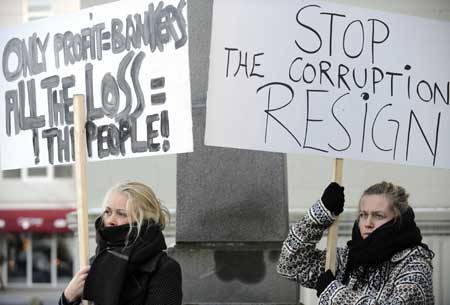
As the saying goes, “there are two sides to every story,” but a more accurate articulation of this phrase would be “in any story, there are multiple sides, viewpoints, opinions and perspectives.” The story in Iceland is no exception. Socialist and Marxist blogs here in the U.S. say that there’s been a massive U.S. news conspiracy and cover up about the revolution in Iceland because the U.S. media is controlled by corporations, including banks, and the “powers that be” don’t want U.S. citizens getting any ideas to stage a revolution of their own. Some conservative Icelandic bloggers claim that while there was, indeed, a revolution, it did not lead to a successful or widely accepted new constitution. They say the situation in Iceland is worse than ever, and that international news reports of an effective democratic uprising leading to a better government are simply myths. Social media commenters are scratching their heads over why they were robbed of the story of Iceland’s pots and pans revolution.
As with most narratives, the truth may lie somewhere in the middle of all of these varying perspectives. One thing is clear, though: it’s nearly impossible to find one mainstream U.S. news report of the pots and pans revolution in Iceland, the resignation of Iceland’s entire government, and the jailing of the bankers responsible for the economic collapse there. Whether or not the revolution led to a more fair government or a workable and effective constitution is irrelevant to the fact that the U.S. media has essentially skipped over this story for the past five years.
Is it possible that mainstream media sources purposely covered up the Iceland story to appease their corporate sponsors? It doesn’t seem likely, and yet, what explanation could be given as to why this news never made it to the front pages of our most trusted media organizations here in the U.S.?
As Iceland struggles to regain its footing with a new government, U.S. citizens may or may not be able to look to Iceland as an example of perfect democracy in action. The real question, though, is why weren’t U.S. citizens given the information about the ousting of the Icelandic government and the jailing of the unscrupulous bankers? Are journalists in control of the mainstream media or is there some truth to accusations that big business may, in fact, be strong-arming reporters to keep quiet about world events that could inspire similar actions here in the U.S.?
Tuesday, December 3, 2013
RF Safe-Stop shuts down car engines with radio pulse

A British company has demonstrated a prototype device capable of stopping cars and other vehicles using a blast of electromagnetic waves.
The RF Safe-Stop uses radio frequency pulses to "confuse" a vehicle's electronic systems, cutting its engine.
E2V is one of several companies trying to bring such a product to market.
It said it believed the primary use would be as a non-lethal weapon for the military to defend sensitive locations from vehicles refusing to stop.
There has also been police interest.
The BBC was given a demonstration of the device at Throckmorton Airfield, in Worcestershire.
Deputy Chief Constable Andy Holt, of the Association of Chief Police Officers (Acpo), who has evaluated the tech, said the machine had "potential, but it's very early days yet".
Radio pulseAt one end of a disused runway, E2V assembled a varied collection of second-hand cars and motorbikes in order to test the prototype against a range of vehicles.
In demonstrations seen by the BBC a car drove towards the device at about 15mph (24km/h).
As the vehicle entered the range of the RF Safe-stop, its dashboard warning lights and dials behaved erratically, the engine stopped and the car rolled gently to a halt. Digital audio and video recording devices in the vehicle were also affected.
"It's a small radar transmitter," said Andy Wood, product manager for the machine.
"The RF [radio frequency] is pulsed from the unit just as it would be in radar, it couples into the wiring in the car and that disrupts and confuses the electronics in the car causing the engine to stall."
He did not provide other specifics. However, the Engineer magazine has reported the device uses L- and S-band radio frequencies, and works at a range of up to 50m (164ft).
Some experts the BBC has spoken with suggested that turning off the engine in this manner would not stop vehicles rapidly enough. Others worried about what effect it might have on a car's electronic brake and steering systems.
But E2V said the risks were lower than with alternative systems.
Acpo suggested the machine's ability to stop motorbikes "safely" could prove particularly useful.
Mr Holt noted that the tyre deflation devices used by some police forces posed the risk of causing "serious injury" if used against two-wheelers.
E2V added that its device could also be effective against other types of vehicles, including boats.
But because the device works on electronic systems, he acknowledged that it would not work on all older vehicles.
"Certainly if you took a 1960s Land Rover, there's a good chance you're not going to stop it," Mr Wood said.
The firm added that it did not believe the RF Safe-Stop posed any risk to people using a pacemaker.
Listeners in the UK can hear more about the device on BBC Radio 4's PM programme between 17:00 and 18:00 on Tuesday.