Saturday, November 10, 2012

Is Genetically Modified Food Killing Us?

Last month, a group of Australian scientists published a warning to the citizens of the country and of the world who collectively gobble up some $34 billion annually of its agricultural exports. The warning concerned the safety of a new type of wheat.

As Australia's number-one export, a $6-billion annual industry, and the most-consumed grain locally, wheat is of the utmost importance to the country. A serious safety risk from wheat – a mad wheat disease of sorts – would have disastrous effects for the country and for its customers.

Which is why the alarm bells are being rung over a new variety of wheat being ushered toward production by the Commonwealth Scientific and Industrial Research Organisation (CSIRO) of Australia. In a sense, the crop is little different than the wide variety of modern genetically modified foods. A sequence of the plant's genes has been turned off to change the wheat's natural behavior a bit, to make it more commercially viable (hardier, higher yielding, slower decaying, etc.).

Franken-Wheat?

What's really different this time – and what has Professor Jack Heinemann of the University of Canterbury, NZ, and Associate Professor Judy Carman, a biochemist at Flinders University in Australia, holding press conferences to garner attention to the subject – is the technique employed to effectuate the genetic change. It doesn't modify the genes of the wheat plants in question; instead, a specialized gene blocker interferes with the natural action of the genes.

The process at issue, dubbed RNA interference or RNAi for short, has been a hotbed of research activity ever since the Nobel Prize-winning 1997 research paper that described the process. It is one of a number of so-called "antisense" technologies that help suppress natural genetic expression and provide a mechanism for suppressing undesirable genetic behaviors.

RNAi's appeal is simple: it can potentially provide a temporary, reversible off switch for genes. Unlike most other genetic modification techniques, it doesn't require making permanent changes to the underlying genome of the target. Instead, specialized siRNAs – chemical DNA blockers based on the same mechanism our own bodies use to temporarily turn genes on and off as needed – are delivered into the target organism and act to block the messages cells use to express a particular gene. When those messages meet with their chemical opposites, they turn inert. And when all of the siRNA is used up, the effect wears off.

The new wheat is in early-stage field trials (i.e., it's been planted to grow somewhere, but has not yet been tested for human consumption), part of a multi-year process on its way to potential approval and not unlike the rigorous process many drugs go through. The researchers responsible are using RNAi to turn down the production of glycogen. They are targeting the production of the wheat branching enzyme which, if suppressed, would result in a much lower starch level for the wheat.

The result would be a grain with a lower glycemic index – i.e., healthier wheat.

This is a noble goal. However, Professors Heinemann and Carman warn, there's a risk that the gene silencing done to these plants might make its way into humans and wreak havoc on our bodies. In their press conference and subsequent papers, they describe the possibility that the siRNA molecules – which are pretty hardy little chemicals and not easily gotten rid of – could wind up interacting with our RNA.

If their theories prove true, the results might be as bad as mimicking glycogen storage disease IV, a super-rare genetic disorder which almost always leads to early childhood death.

"Franken-Wheat Causes Massive Deaths from Liver Failure!"

Read more: Casey Research

Millions of GMO Mosquitoes Released Without Risk Assessment or Oversight

Barbara H. Peterson

Farm Wars

Look out people of planet earth, genetically engineered bugs are here. Just in case you haven’t figured it out yet, our technocracy is working ever diligently on genetically engineering every last living cell on the planet – WITHOUT EXCEPTION. What does this mean for life here on earth? Ever hear the expression “soup sandwich?” Well, after these “scientific” geniuses are through with us, that is exactly what all life will be – a genetic soup sandwich, made in a lab, and stamped with a corporate logo embedded in our DNA.

If the following report from Testbiotech doesn’t send chills up your spine, I don’t know what will. Get ready world, because nothing will ever be the same. Ever. There is no remediation technique available to clean up genetically engineered mutations released into the wild and spread through horizontal gene transfer. Barb

Regulatory decisions on releasing genetically modified (GM) insects biased by corporate interests

Dr Helen Wallace, Director of GeneWatch UK said “The public will be shocked to learn that GM insects can be released into the environment without any proper oversight. Conflicts-of-interest should be removed from all decision-making processes to ensure the public have a proper say about these plans.”

London/ Munich Thursday 8th November 2012 A briefing published today by public interest groups highlights how regulatory decisions on GM insects in Europe and around the world are being biased by corporate interests.

The briefing shows how UK biotech company Oxitec has infiltrated decision-making processes around the world. The company has close links to the multinational pesticide and seed company, Syngenta. Oxitec has already made large-scale open releases of GM mosquitoes in the Cayman Islands, Malaysia and Brazil and is developing GM agricultural pests, jointly with Syngenta. Plans to commercialise GM insects would result in many millions of GM insects being released in fields of crops, including olives, tomatoes, citrus fruits, cabbages and cotton. In future, any insect species might be genetically modified.

The European Food Safety Authority (EFSA) is highlighted as one of several examples showing how industry organises its influence. In EFSA´s GM insects working group, which was established to develop guidance for risk assessment of genetically engineered insects, there are several cases of conflicts of interest, including experts with links to Oxitec who only partially declared their interests. The draft Guidance on risk assessment of GM insects shows some significant deficiencies: for example it does not consider the impacts of GM insects on the food chain. Oxitec’s GM insects are genetically engineered to die mostly at the larval stage so dead GM larvae will enter the food chain inside food crops such as olives, cabbages and tomatoes. Living GM insects could also be transported on crops to other farms or different countries. EFSA has excluded any consideration of these important issues from its draft guidance. Many other issues are not properly addressed.

The briefing also highlights problems with a World Health Organisation (WHO)-funded project which has allowed the company to bypass requirements for informed consent for the release of GM mosquitoes. The WHO-funded Mosqguide project, which was supposed to be developing best practice, also allowed the company to gain approval from Brazilian regulators to release 16 million GM mosquitoes before draft regulations on the release of GM insects had been finalised or adopted, without publishing a risk assessment.

Dr Helen Wallace, Director of GeneWatch UK said “The public will be shocked to learn that GM insects can be released into the environment without any proper oversight. Conflicts-of-interest should be removed from all decision-making processes to ensure the public have a proper say about these plans.”

Christoph Then, Executive Director, Testbiotech, said: “Risk assessment of genetically engineered animals touches many areas where there is lack of knowledge. We are concerned that EFSA will apply a biased and selective protocol to safety without really sorting out potential hazards.”

François Meienberg, Berne Declaration, said: “Companies such as Syngenta and Oxitec have to learn that negative impacts on the environment or health can arise from their lobbying activities. To act responsibly they have to change their lobbying behaviour immediately.”

Nina Holland, Corporate Europe Observatory (CEO), said: “Experts on EFSA’s working groups should not be allowed to have any conflict of interests with industry, let alone ties with companies producing the very product they are assessing – in this case GM insects. This clearly shows that EFSA’s rules to deal with conflicts of interest still have major gaps.”

Tina Goethe, SwissAid, said: “The development of GM-insects for agriculture implies unforeseeable risks for human health and environment. In order to meet the challenges of small scale agriculture in poor countries, we do not need expensive and high risk technologies, but agro-ecological solutions.”

The briefing highlights multiple attempts by Oxitec to influence regulation around the world, which have included:

  • Attempts to define ‘biological containment’ of the insects (which are programmed to die at the larval stage) as contained use, by-passing requirements for risk assessments and consultation on decisions to release GM insects into the environment;
  • Attempts to avoid any regulation of GM agricultural pests on crops which will end up in the food chain;
  • Avoidance of any discussion of how GM insects can be contained at a site, or products produced using GM insects can be labelled;
  • Exclusion of many important issues from risk assessments, including impacts of surviving GM mosquitoes on the environment and health, and impacts of changing mosquito populations on human immunity and disease;
  • Failure to follow transboundary notification processes for exports of GM insects correctly;
  • Undermining the requirement to obtain informed consent for experiments involving insect species which transmit disease;
  • Attempts to avoid liability for any harm if anything goes wrong;
  • Pushing ahead with large-scale open releases of GM mosquitoes before relevant guidance or regulations are adopted.

Source: Farm wars

It’s official. Goodbye Windows live Messenger. Hello Skype.

We've got good news to share! Skype and Messenger are coming together. Millions of Messenger users will be able to reach their Messenger friends on Skype. By updating to Skype, Messenger users can instant message and video call their Messenger friends.

This effort started with the release of Skype 6.0 for Mac and Windows a few weeks ago, which allows you to sign into Skype using a Microsoft account. Now Messenger users just need to update to the latest version of Skype, sign in using a Microsoft account, and their Messenger contacts will be there.

Our goal remains to deliver the best communications experience for everyone, everywhere. We want to focus our efforts on making things simpler for our users while continuously improving the overall experience. We will retire Messenger in all countries worldwide in the first quarter of 2013 (with the exception of mainland China where Messenger will continue to be available).

Once you update to Skype, here are some of the other great features Messenger users can expect:

• Broader device support for all platforms, including iPad and Android tablets
• Instant messaging, video calling, and calling landlines and mobiles all in one place
• Sharing screens
• Video calling on mobile phones
• Video calling with Facebook friends
• Group video calling

We will work with you over the next few months to help you transition and offer information and help along the way. To help you learn how to get the most out of Skype, be on the lookout for some special offers later this year as you join your Messenger friends in the migration. We think you will enjoy using Skype, and encourage you to download the latest version, sign in with your Microsoft account, and experience it for yourself.

Here is a quick look at what you, as a Messenger user, can do to talk to your Messenger contacts on Skype:

On the sign in screen, select the option to sign in with your Microsoft account. You will be asked if you are already using Skype or are a new user.

WLM Blog 1.png

If you use Skype and Messenger already, you can merge your Skype and Messenger account into your Microsoft account.

WLM Blog 2.png

When you complete the installation process you will be welcomed into Skype with your buddy list already synced into your Skype contact list.

WLM BLog 3.png

And you can start instant messaging right away!

WLM Blog 4.png

We'd love to hear your feedback. Discuss what matters to you on the Skype Support Network or share your feedback on Twitter with hashtag #SkypeWLM. We are here to help!

Friday, November 9, 2012

The People’s Bailout

This is a long post but it’s about something pretty interesting so I hope you’ll indulge …

Like many folks, Occupy Wall Street has been some doing good work in the aftermath of Hurricane Sandy, helping people on the ground.

Now OWS is launching the ROLLING JUBILEE, a program that has been in development for months. OWS is going to start buying distressed debt (medical bills, student loans, etc.) in order to forgive it. As a test run, we spent $500, which bought $14,000 of distressed debt. We then ERASED THAT DEBT. (If you’re a debt broker, once you own someone’s debt you can do whatever you want with it — traditionally, you hound debtors to their grave trying to collect. We’re playing a different game. A MORE AWESOME GAME.)

This is a simple, powerful way to help folks in need — to free them from heavy debt loads so they can focus on being productive, happy and healthy. As you can see from our test run, the return on investment approaches 30:1. That’s a crazy bargain!

Now, after many consultations with attorneys, the IRS, and our moles in the debt-brokerage world, we are ready to take the Rolling Jubilee program LIVE and NATIONWIDE, buying debt in communities that have been struggling during the recession.

We’re kicking things off with a show called THE PEOPLE’S BAILOUT at Le Poisson Rouge on Thursday, November 15. It will also stream online, like a good ol’-fashioned telethon!


Friends, the line-up is insane. Performers include:

- JEFF MANGUM (Neutral Milk Hotel)

- JANEANE GAROFALO

- GUY PICCIOTTO (Fugazi)

- LIZZ WINSTEAD

- HARI KONDABOLU

- TUNDE ADEBIMPE and KYP MALONE (TV on the Radio)

- members of DAS RACIST

and other great talents including a group of radical nuns! I’ll be playing the role of JERRY LEWIS, emceeing in my tuxedo from MEN’S WEARHOUSE.

This will be a joyful, positive night about people banding together and subverting a predatory financial system in order to help each other. BOOM! That’s a movie pitch right there, goddamn why am I not a Hollywood mogul?!

Anyway, HERE IS THE INFORMATION about THE PEOPLE’S BAILOUT:

- The LIVE SHOW is at Le Poisson Rouge on THURSDAY 11/15, 8 - 11 PM. Tickets are $25 (each ticket buys $500 of distressed debt).

- The LIVE STREAM will be at http://rollingjubilee.org (you’ll be able to donate online)

- Here’s the FACEBOOK PAGE

- The HASHTAG is #peoplesbailout

HOW YOU CAN HELP:

- Spread the word! Share this info with your friends, family, and followers
- Donate money via http://rollingjubilee.org

$25 abolishes an estimated $500 worth of debt
$50 abolishes an estimated $1000 worth of debt
$100 abolishes an estimated $2000 worth of debt
$250 abolishes an estimated $5000 worth of debt

- Host a live-stream party! Get together with folks in your town and watch the show online and donate money and maybe even drink a beer if you’re feeling crazy.

- If you are Jerry Seinfeld or Bill Cosby: Call me about doing a set at the live show! We’ll fit you in.

Okay, that was a really long tumblr post. I feel very vulnerable right now. Thanks for reading.

Bye!
—David Rees

Source: Wil Wheaton

Thursday, November 8, 2012

McDonald's Same-Store Sales Crumble All Around The World

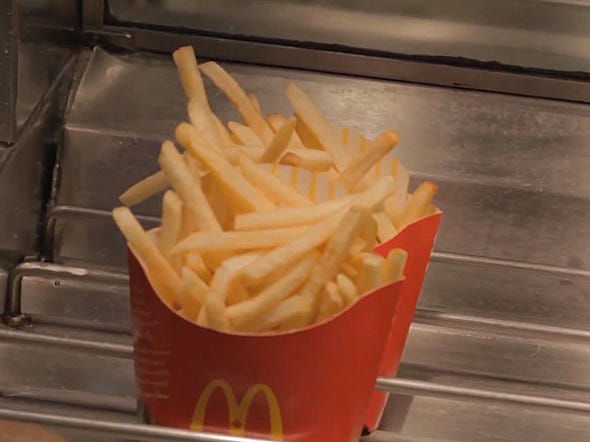
mcdonalds fries

Screengrab from McDonaldsCanada on YouTube

Pretty ugly same-store sales from McDonald's.

Here's the key part of the press release.

---------------------

McDonald's Corporation today announced that global comparable sales decreased 1.8% in October.  Performance by segment was as follows:

  • U.S. down 2.2%
  • Europe down 2.2%
  • Asia/Pacific, Middle East and Africa down 2.4%

"The McDonald's System remains focused on serving the evolving needs of our more than 69 million customers daily," said McDonald's President and Chief Executive Officer Don Thompson.  "Though October's sales results reflect the pervasive challenges of today's global marketplace, I am confident that our strategies and the adjustments we are making in response to the current business headwinds will build sales momentum and drive sustained, profitable growth."

In October, U.S. comparable sales decreased 2.2%.  Modest consumer demand and heightened competitive activity offset the impact of local Dollar Menu advertising, the Monopoly promotion, and the recent launch of the Cheddar Bacon Onion premium sandwiches.  Moving forward, the U.S. remains focused on enhancing its value leadership position by balancing strong everyday value messaging with affordable premium menu options.

In Europe, comparable sales declined 2.2% as positive results in the U.K. were offset by declines across many markets.  Amid the segment's ongoing economic uncertainty, Europe is reinvigorating its value offerings through increased advertising and new meal combinations at various price tiers, featuring core and premium menu items, and enhancing the restaurant experience to attract more customers.

In Asia/Pacific, Middle East and Africa (APMEA), October's comparable sales declined 2.4% with negative results in Japan, Australia and other markets, including China.  Looking ahead, APMEA seeks to further differentiate the McDonald's experience through unique daypart value platforms, locally-relevant menu choices and unmatched customer conveniences.

Source: Business Insider

Total hypocrisy: Monsanto, agribusiness and big food companies spent more than $45 million to kill 'costly' Prop 37 GMO labeling bill

Labeling genetically-modified organisms (GMOs) is simply too costly, and any law requiring that GMOs be properly labeled will raise food prices significantly. This was one of the many lies propagated by the biotechnology and processed food industries in the months and weeks leading up to the vote on Proposition 37 in California, the historic GMO labeling initiative that was defeated in large part due to the more than $45 million that Monsanto, Dow, Kraft Foods, and dozens of other industry players hypocritically pumped into the fraudulent No on 37 campaign during the final hour.

For the past few weeks, Californians have had to endure a seemingly endless barrage of misleading television commercials and phony voter guide mailers urging them to vote against the labeling proposal because it would allegedly "cost taxpayers and consumers millions," to quote California "family farmer" Ted Sheely, who was prominently featured in a No on 37 propaganda commercial that aired throughout the state. The same commercial, along with several others, also claimed that GMO labeling would increase grocery bills by about $400 per year for the average California family.

Such claims are bald-faced lies, of course, as food manufacturers change their labels constantly without issue, not to mention the fact that the supposed "Prop 37 Economic Impact Study" from which many of these bogus claims and figures were pulled is nothing but fabricated, industry-backed nonsense. Even so, these nonstop lies were apparently enough to close the gap on an earlier 2-to-1 lead in favor of the bill -- The Los Angeles Times reported back in September that 61 percent of registered voters supported Prop. 37, while only 25 percent opposed it.

Labeling GMOs is apparently too costly, but spending millions to fight labeling is no big deal

So what happened to cause the bill to eventually fail in the eleventh hour? Nearly $50 million in lobbying funds is what happened. In a demonstration of sheer irony and hypocrisy, the same companies that have been complaining about supposed food cost increases from GMO labeling are the very ones that spent tens of millions of dollars making sure the GMO labeling bill did not pass. And in the end, the GMO cartel got its wish, at least in the short term.

The good news, however, is that more than 4.2 million Californians saw through the lies of Monsanto, and voted in favor of Prop. 37 despite the propaganda campaign. And the long-term momentum the Yes on 37 campaign generated about the presence of GMOs in the food supply means it is only a matter of time before GMOs are eventually on the radar of all Americans.

"Yesterday, we showed that there is a food movement in the United States, and it is strong, vibrant and too powerful to stop," said the Yes on 37 campaign following the election. "We always knew we were the underdogs, and the underdogs nearly took the day. Dirty money and dirty tactics may have won this skirmish, but they will not win the war."

To begin proactively fighting against the unlabeled presence of GMOs throughout the American food supply, be sure to check out the Label It Yourself initiative.

Also, be sure to boycott the "natural" and organic imposters that contributed to the No on 37 campaign, and support those that fought for the people's right to know what they are eating and feeding their families.

Source: Natural News