Thursday, June 6, 2013

Top U.S. Brand of Children’s Vitamins Contains Aspartame, GMOs & Other Hazardous Chemicals

The #1 Children’s Vitamin Brand in the US contains ingredients that most parents would never intentionally expose their children to. So why aren’t more opting for healthier alternatives?

Kids vitamins are supposed to be healthy, right? Well then, what’s going on with Flintstones Vitamins, which proudly claims to be “Pediatricians’ #1 Choice”? Produced by the global pharmaceutical corporation Bayer, this wildly successful brand features a shocking list of unhealthy ingredients, including:

On Bayer Health Science’s Flintstones product page designed for healthcare professionals they lead into the product description with the following tidbit of information:

“82% of kids aren’t eating all of their veggies1. Without enough vegetables, kids may not be getting all of the nutrients they need.”

(References: 1. Lorson BA, Melgar-Quinonez HR, Taylor CA. Correlates of fruit and vegetable intakes in US children. J Am Diet Assoc. 2009;109(3):474-478.)

The implication? That Flintstones vitamins somehow fill this nutritional void. But let’s look a little closer at some of these presumably healthy ingredients….

Aspartame

Aspartame is a synthetic combination of the amino acids aspartic acid and l-phenylalanine, and is known to convert into highly toxic methanol and formaldehyde in the body.  Aspartame has been linked to over 40 adverse health effects in the biomedical literature, and has been shown to exhibit both neurotoxicity and carcinogenicity. [1]  What business does a chemical like this have doing in a children’s vitamin, especially when non-toxic, non-synthetic non-nutritive sweeteners like Stevia already exist?

Cupric Oxide

Next, let’s look closer at Cupric Oxide, 2mg of which is included in each serving of Flinstone’s Complete chewable vitamins as a presumably  ’nutritional’ source of ‘copper,’ supplying “100% of the Daily Value  (Ages 4+), according to Flintstones Vitamins Web site’s Nutritional Info. [2]

But what is Cupric Oxide? A nutrient or a chemical?

According to the European Union’s Dangerous Substance Directive, one of the main EU laws concerning chemical safety, Cupric Oxide is listed as a Hazardous substance, classified as both  ”Harmful (XN)” and “Dangerous for the environment” (N).  Consider that it has industrial applications as a pigment in ceramics, and as a chemical in the production of rayon fabric and dry cell batteries. In may be technically correct to call it a mineral, but should it be listed as a nutrient in a children’s vitamin? We think not.
flinstones_vitamins2(1)

Coal Tar Artificial Coloring Agents

A well-known side effect of using synthetic dyes is attention-deficit hyperactivity disorder. For direct access to study abstracts on this topic view GreenMedInfo’s Food Coloring research page. There is also indication that the neurotoxicity of artificial food coloring agents increase when combined with aspartame,[3] making the combination of ingredients in Flintstones even more concerning.

Zinc Oxide

Each serving of Flinstones Complete Chewable vitamins contain 12 mg of zinc oxide, which the manufacturer claims delivers 75% of the Daily Value to children 2  & 3 years of age. Widely used as a sun protection factor (SPF) in sunscreens, The EU’s Dangerous Substance Directive classifies it as an environmental Hazard, “Dangerous for the environment (N).” How it can be dangerous to the environment, but not for humans ingesting it, escapes me. One thing is for sure, if one is to ingest supplemental zinc, or market it for use by children, it makes much more sense using a form that is organically bound (i.e. ‘chelated’) to an amino acid like glycine, as it will be more bioavailable and less toxic.

Sorbitol

Sorbitol is a synthetic sugar substitute which is classified as a sugar alcohol. It can be argued that it has no place in the human diet, much less in a child’s. The ingestion of higher amounts have been linked to gastrointestinal disturbances from abdominal pain to more serious conditions such as irritable bowel syndrome. [4]

Ferrous Fumarate

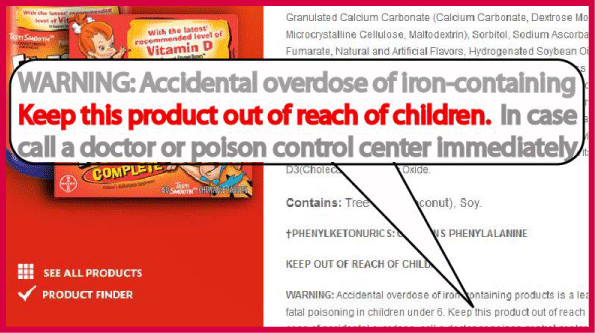
The one clear warning on the Flinstone’s Web site concerns this chemical. While it is impossible to die from consuming iron from food (e.g. spinach) ferrous fumarate is an industrial mineral and not found in nature as food. In fact, ferrous fumarate is so toxic that accidental overdose of products containing this form is “a leading cause of fatal poisoning in children under 6.”

The manufacturer further warns:

Keep this product out of reach of children. In case of accidental overdose, call a doctor or poison control center immediately.

Hydrogenated Soybean Oil

Finding hydrogenated oil in anything marketed to children is absolutely unacceptable. These semi-synthetic fatty acids incorporate into our tissues and have been linked to over a dozen adverse health effects, from coronary artery disease to cancer, violent behavior to fatty liver disease. [5]

GMO Corn Starch

While it can be argued that the amount of GMO corn starch in this product is negligible, even irrelevant, we disagree. It is important to hold accountable brands that refuse to label their products honestly, especially when they contain ingredients that have been produced through genetic modification. The ‘vitamin C’ listed as ascorbic acid in Flintstones is likely also produced from GMO corn. Let’s remember that Bayer’s Ag-biotech division, Bayer CropScience, poured $381,600 of cash into defeating the proposition 37 GMO labeling bill in California. Parents have a right to protect their children against the well-known dangers of genetically modified foods and the agrichemicals that contaminate them, don’t they? GMO corn starch is GMO, plain and simple. We’d appreciate it if Bayer would label their “vitamins” accordingly.

In summary, Bayer’s Flintstone’s vitamin brand is far from a natural product, and the consumer should be aware of the unintended, adverse health effects that may occur as a result of using it.

Source: Wake Up World

Wednesday, June 5, 2013

Kraft Foods Denies GM Wheat but ADMITS GMO in Products

Truthstream Media followed up on a report by Vani Hari at Foodbabe.com that boxes of Kraft Macaroni & Cheese imported to the U.K. were showing up with a label warning that the product contained genetically modified wheat. As no forms of GMO wheat are legally approved for cultivation or sale anywhere in the world, we investigated further, contacting both Kraft and the distribution company that placed the label to get the bottom of it.


We started by contacting the company’s customer service number. Listen as the representative admits their products have been ‘enhanced by biotechnology’ so some of their products ‘do contain ingredients from these crops’.

Multiple Scientific Studies Link Pesticides to Cancer

In my article, “Pesticide Content In Food Less Regulated By Codex Than Vitamins and Minerals,” I briefly discussed the connection between commonly used pesticides and neurological disorders such as Parkinson’s Disease. In addition, I mentioned the rather contradictory position held regarding the use of such pesticides, which banned their commercial use in some aspects, but continues to tacitly allow their use in food production.

However, neurological diseases are not the only negative side effects presented by Persistent Organic Pollutants (POPs) or general pesticides. Indeed, pesticides have been linked to cancer as well.

For instance, a study published in Blood, the journal of the American Society of Hematology, found that exposure to certain pesticides doubled an individual’s risk of developing Monoclonal Gammopathy of Undetermined Significance (MGUS) compared to individuals in the general population.[1] MGUS is a “pre-cancerous condition that can lead to multiple layer myeloma which is a painful cancer of the plasma cells the bone marrow.”[2] When one is diagnosed with MGUS, the patient requires life-long monitoring because MGUS is a condition that virtually every multiple layer myeloma patient experiences prior to developing the myeloma.[3]

In addition, in a study conducted as part of the Agricultural Health Study and published in the American Journal of Epidemiology, a potential link between pesticides and prostate cancer was reported. In particular, Methyl Bromide, a gas used to kill pests in the soil and fumigate grain bins and storage areas, was associated with increased risk of the disease by approximately two to four times as much as those who were not exposed to the pesticide. This is not surprising considering the fact that the National Institute for Occupational Safety and Health acknowledges Methyl Bromide as a potential occupational carcinogen.[4]

A link between other pesticides such as chlorpyrifos, coumaphos, fonofos, phorate, permethrin, and butylate, was also established for men who had a family history of prostate cancer. One interesting note regarding this study is that the individuals examined by scientists were compared to the incidence rates of the two states in which the subjects lived. That is, they were compared to the average occurrence of prostate cancer for that area.[5] However, since more in-depth analysis had not been conducted at the time, we have no way of knowing just how many cases of prostate cancer in the average occurrences were caused by pesticide exposure themselves. Such information would be extremely valuable due to the fact that the aforementioned cancer rates could have been caused by pesticide residues in food or proximity to these particular chemicals.

Children, of course, are at particular risk for the adverse effects of pesticides because of their developing biological systems. So it is not entirely surprising that a link between childhood cancers and pesticides has been discovered as well. Researchers from Georgetown University Lombardi Comprehensive Cancer Centre completed a study involving 41 pairs of children with Acute Lymphoblastic Leukemia (ALL) and their mothers who were tested and compared with 41 pairs of healthy children and their mothers. The study found that children with ALL, a cancer that commonly develops before seven years of age, had a higher ratio of household pesticides in their urine than the healthy children, indicating a possible link between the chemical and the cancer.[6]

The link between pesticides and childhood brain cancers are slightly more established, however. In a study published in Environmental Health Perspectives in 2009, researchers confirmed a link between pesticide exposure and increase in astrocytomas (brain cancers).[7] The study confirmed previous research that has suggested a link between industrial and household use of pesticides and herbicides with childhood brain cancer.[8] Not only that, but there is the distinct potential that the parents use or exposure to pesticides may affect the child even before birth. As the study claims,

Parental exposures may act before the child’s conception, during gestation, or after birth to increase the risk of cancer. Before conception, exposures may cause mutations or epi-genetic alterations in gene expression, such as genomic imprinting or DNA methylation, in the sperm or egg. Exposure after conception (i.e. during the pregnancy or after birth) may cause somatic cell mutations or alterations in hormonal or immunological function that affect cancer risk.[9]

Of course, this merely reaffirms the knowledge that humans have possessed for millennia, i.e. that what the parents ingest into their bodies can and probably will affect the child they produce. Pesticides are no different in this respect.

As discussed earlier, pesticides also pose a cancer risk for adults, particularly those who work with these chemicals. A study published in Occupational and Environmental Medicine in June 2007 found that agricultural workers who had the highest exposure to pesticides were 2 times more likely to develop brain cancer as those whose occupations did not bring them into contact with these chemicals. It was also found that those who used pesticides on their house plants were at an elevated risk for brain cancer.[10] Recent research has also suggested that pesticides and industrial chemicals are linked to testicular cancer, genital abnormalities, low amounts and potency of semen, and other male reproductive conditions.[11]

Indeed, the connection between these substances and cancer is widely known. As the researchers mention in the Environmental Health Perspectives study, the EPA itself classifies chlordane, heptachlor, tetrachlorvinphos, carbaryl, and propoxur as probable or likely carcinogens to humans and lindane, dichlorvos, phosmet, and permethrin as suggestive or possible carcinogens.[12]

While it is not known exactly how these chemicals cause cancer, it is known that many pesticides exude hormone-mimicking, mutagenic, and/or immune-hampering qualities and these properties have been linked to cancer in their own right.[13]

As I mentioned in my last article regarding this subject, neurological and developmental problems are also associated with pesticide exposure. This is not surprising considering the fact that many insecticides kill their targets by attacking their nervous systems.

As with other concerns, children are at highest risk, including those still in the womb.

Although more research has been conducted on the effects of some these chemicals on animals than humans, researchers suggest that these effects are quite similar. As a study published in the Canadian Medical Association Journal states,
Neuordevelopmental, hematological, immunologic, and reproductive effects have been found in animals at levels of exposure that overlap the range of exposures and body burdens found in humans. The health effects of POPs in humans is unclear, although available epidemiological evidence suggest they are similar to those in animals, affecting neurodevelopment, and thyroid, estrogen, and immune function. The developing brain and immune system may be most vulnerable.[14]
While toxicity of pesticides in humans may not have been studied ad naseum, it is safe to say that it is, nevertheless, well established. In a more recent study published in Frontiers In Bioscience, it was stated more directly. The authors write,
Most pesticides are not highly selective, and are also toxic to nontarget species, including humans. A number of pesticides can cause neurotoxicity. Insecticides, which kill insects by targeting their nervous system, have neurotoxic effect in mammals as well. . . . . . Insecticides interfere with chemical neurotransmission or ion channels, and usually cause reversible neurotoxic effects, that could nevertheless be lethal. Some herbicides and fungicides have also been shown to possess neurotoxic properties. The effects of pesticides on the nervous system may be involved in their acute toxicity, as in case of most insecticides, or may contribute to chronic neurodegenerative disorders, most notably Parkinson’s disease.[15]
In past research there have also been connections drawn between Persistant Organic Pollutants and diabetes. In a cohort study published in 2006, serum concentrations of POPs (Persistent Organic Pollutants) were examined in accordance with diabetes prevalence. What the scientists found was “striking dose-response relations between serum concentrations of six selected POPs and the prevalence of diabetes.”[16]

Although, admittedly, there are several limitations to this particular study, clearly this is a subject that needs to be further investigated. Indeed, it would be wise, considering the growing corporate structure and mass-produced nature of the world’s agriculture, to fund and conduct a number of independent studies investigating the safety of pesticides used on food and the possible side effects of their use.

Source: Activist Post

Mind-Controlled Drones Take Flight

Electronics turn a person's thoughts into commands for a robot. Using a brain-computer interface technology pioneered by University of Minnesota biomedical engineering professor Bin He, several young people have learned to use their thoughts to steer a flying robot around a gym, making it turn, rise, dip, and even sail through a ring.

Honeybee food may contribute to U.S. colony collapse - study

Bee keepers' use of corn syrup and other honey substitutes as bee feed may be contributing to colony collapse by depriving the insects of compounds that strengthen their immune systems, according to a study released on Monday.

U.S. bee keepers lost nearly a third of their colonies last winter as part of an ongoing and largely unexplained decline in the population of the crop-pollinating insects that could hurt the U.S. food supply.

A bee's natural food is its own honey, which contains compounds like p-coumaric acid that appear to help detoxify and strengthen a bee's immunity to disease, according to a study by scientists at the University of Illinois.

Bee keepers, however, typically harvest and sell the honey produced by the bees and use substitutes like sugar or high-fructose corn syrup to feed them.

"The widespread apicultural use of honey substitutes, including high-fructose corn syrup, may thus compromise the ability of honey bees to cope with pesticides and pathogens and contribute to colony losses," according to the study, which was published on May 28 in the Proceedings of the National Academy of Sciences.

The U.S. Department of Agriculture and the Apiary Inspectors of America said in May that more than 30 percent of America's managed honeybee colonies were lost during the winter of 2012-13, up sharply from around 22 percent the previous winter but still close to the six-year average. The losses vary year to year, but a huge and prolonged multiyear decline threatens the species and crop pollination.

Honeybees pollinate fruits and vegetables that make up roughly one-quarter of the American diet, and scientists are split over whether pesticides, parasites or habitat loss are mainly to blame for the deaths.

Similar losses have been recorded in Europe where lawmakers have moved to ban three of the world's most widely used pesticides for two years amid growing criticism from environmental activists.

Agrichemical and pesticide makers like Monsanto, Bayer AG and Syngenta are also launching projects to study and counter colony collapse.

Few deny that pesticides - particularly a class of commonly used insecticides called neonicotinoids - can be harmful to bees in the laboratory. It is unclear what threat the insecticides pose under current agricultural usage. Some scientists say habitat decline and disease-carrying parasites, such as the Varroa mite, are the chief cause of bee deaths.

Source: Reuters

FBI pushes for wiretap-friendly Internet

A new wiretap bill backed by the FBI has many Internet companies concerned that this new proposed legislation will open the floodgates to all Internet communication. The new motion will expand wiretapping designs significantly and includes the ability for law enforcement to gain access to emails and features like video chats.


Amazon makes a move to be your grocery store

 A zoomed illustration image of a man looking at a computer monitor showing the Amazon.com logo.

Amazon.com founded a grocery delivery service that has been active in the Greater Seattle area. In a major move, the company plans to expand the business outside Seattle for the first time.

SAN FRANCISCO — Amazon.com is planning a major rollout of an online grocery business that it has been quietly developing for years, targeting one of the largest retail sectors yet to be upended by e-commerce, according to two people familiar with the situation.

The company has been testing AmazonFresh in its hometown of Seattle for at least five years, delivering fresh produce such as eggs, strawberries and meat with its own fleet of trucks.

Amazon is now planning to expand its grocery business outside Seattle for the first time, starting with Los Angeles as early as this week and the San Francisco Bay Area later this year, according to the two people, who were not authorized to speak publicly.

If those new locations go well, the company may launch AmazonFresh in 20 other urban areas in 2014, including some outside the United States, said one of the two people.

Related: Your Grocery Aisle Survival Guide

Bill Bishop, a supermarket analyst and consultant, said the company was targeting as many as 40 markets, without divulging how he knew of Amazon's plans.

An Amazon spokeswoman did not respond to a request for comment on Tuesday.

Amazon is searching for new, large markets to enter as the company tries to maintain a growth rate that has fueled a 220 percent surge in its shares over the past five years. The grocery business in the United States, which generated $568 billion in retail sales last year, may be a ripe target.

Amazon's expansion plans are a potential threat to grocery chains such as Kroger, Safeway and Whole Foods Market, as well as general-merchandise retailers Wal-Mart Stores and Target, which also sell a lot of groceries.

"Amazon has been testing this for years, and now it's time for them to harvest what they've learned by expanding outside Seattle," said Bishop, chief architect at Brick Meets Click, a consulting firm focused on retail technology.

"The fear is that grocery is a loss leader and Amazon will make a profit on sales of other products ordered online at the same time," he said. "That's an awesomely scary prospect for the grocery business."

Kroger, Whole Foods, Supervalu and Safeway did not respond to requests for comment on Tuesday. Target declined to comment.

Related: 10 Things Your Grocery Store Doesn't Want You to Know

A successful foray into groceries could also help underwrite the development of a broad-based delivery service employing Amazon trucks to deliver directly to homes, which could have implications for UPS, FedEx and other package delivery companies that currently ship Amazon goods.

Still, groceries have proved to be one of the most difficult sectors for online retailers to crack. One of the most richly funded startups of the dot-com era, Webvan, was a spectacular failure, as the cost of developing the warehouse and delivery infrastructure proved overwhelming.

Roger Davidson, a former grocery executive at Wal-Mart, Whole Foods and Supervalu, said Amazon will struggle to make money from AmazonFresh because fresh produce can easily go bad in storage warehouses and get damaged during delivery — something known as "shrink" in the business.

"Will it work? I would bet against it," Davidson said. "The reasons these businesses have failed in the past have not gone away."

COMPETITION

Still, Amazon is not alone in wanting to expand in the online grocery business.

Wal-Mart is testing same-day and next-day delivery of online grocery and general-merchandise orders in the San Francisco Bay Area and operates a "highly successful" grocery delivery business in Britain.

"We are ready and able to expand grocery delivery in the U.S. as the market demands," Wal-Mart spokesman Dan Toporek said.

Related: Amazon.com's most well-read city: Alexandria, Va.

FreshDirect delivers food to homes and offices in some parts of New York City and is trying to expand its service into the Bronx.

Peapod, owned by international food giant Royal Ahold, says on its website that it is the largest Internet grocer in the United States, delivering more than 23 million orders across 24 markets.

Davidson, who worked at Ahold for several years, said Peapod lost money for most of its existence but has begun to turn a small profit because it does not have much competition in cities like Chicago.

Davidson favors a strategy he calls "Click and Connect," which is being used by Harris Teeter, a food and pharmacy chain on the East Coast. Customers order food online and choose a time to pick up the produce from designated areas outside the company's stores. There is a $4.95 service fee.

"Traditional grocery retailers will likely fight back against Amazon with Click and Connect," he added.

PROGRESS

It is not clear whether AmazonFresh in Seattle is profitable, because Amazon does not disclose results from the business.

Amazon Chief Executive Jeff Bezos was asked about the business during the company's annual shareholder meeting last month. He said that the team had "made progress on the economics over the last year."

"They've been doing a lot of experiments and trying to get the right mixture of customer experience and economics," he added.

Source: MSN