Monday, April 29, 2013


Sunday, April 28, 2013
FBI Documents Shine Light on Clandestine Cellphone Tracking Tool

What's more dangerous: a real stingray or the FBI's Stingray tool?
The FBI calls it a “sensitive investigative technique” that it wants to keep secret. But newly released documents that shed light on the bureau’s use of a controversial cellphone tracking technology called the “Stingray” have prompted fresh questions over the legality of the spy tool.
Functioning as a so-called “cell-site simulator,” the Stingray is a sophisticated portable surveillance device. The equipment is designed to send out a powerful signal that covertly dupes phones within a specific area into hopping onto a fake network. The feds say they use them to target specific groups or individuals and help track the movements of suspects in real time, not to intercept communications. But by design Stingrays, sometimes called “IMSI catchers,” collaterally gather data from innocent bystanders’ phones and can interrupt phone users’ service—which critics say violates a federal communications law.
The FBI has maintained that its legal footing here is firm. Now, though, internal documents obtained by the Electronic Privacy Information Center, a civil liberties group, reveal the bureau appears well aware its use of the snooping gear is in dubious territory. Two heavily redacted sets of files released last month show internal Justice Department guidance that relates to the use of the cell tracking equipment, with repeated references to a crucial section of the Communications Act which outlines how “interference” with communication signals is prohibited.
It’s a small but significant detail. Why? Because it demonstrates that “there are clearly concerns, even within the agency, that the use of Stingray technology might be inconsistent with current regulations,” says EPIC attorney Alan Butler. “I don't know how the DOJ justifies the use of Stingrays given the limitations of the Communications Act prohibition.”
The FBI declined a request to comment on specific questions related to the legality of Stingrays, as it says the matter remains in litigation. Spokesman Christopher Allen told me by email that “in general the FBI cautions against drawing conclusions from redacted FOIA documents.”
A potential legal conflict, however, is not all the documents draw attention to. They disclose that the feds have procedures in place for loaning electronic surveillance devices (like the Stingray) to state police. This suggests the technology may have been used in cases across the United States, in line with a stellar investigation by LA Weekly last year, which reported that state cops in California, Florida, Texas, and Arizona had obtained Stingrays. More still, the trove offers a rare hint at the circumstances in which Stingrays are deployed. “Violent Gang Safe Street Task Forces Legal Issues" is the title of one newly released set of FBI presentation slides related to tracking tactics.
It’s likely that in the months ahead, a few more interesting nuggets of information will emerge. The FBI has told EPIC that it holds a mammoth 25,000 pages of documents that relate to Stingray tools, about 6,000 of which are classified. The Feds have been drip-releasing the documents month by month, and so far there have been four batches containing between 27 and 184 pages each. Though most of the contents—even paragraphs showing how the FBI is interpreting the law—have been heavy-handedly redacted, several eyebrow-raising details have made it through the cut. As I reported back in October, a previous release revealed the Feds have an internal manual called “GSM cellphone tracking for dummies.”
The release of the documents was first prompted last year after EPIC launched a lawsuit under the Freedom of Information Act. The suit was triggered after it emerged during a court case in 2011 that the feds had used a cell-site simulator in order to track down a suspect, with one agent admitting in an affidavit that the tool collaterally swept up data on “innocent, non-target devices” (U.S. v. Rigmaiden). The government has previously argued that tools like the Stingray are permissible without a search warrant—outside the search and seizure protections offered by the Fourth Amendment—because they use them to gather location data, not the content of communications. The Justice Department says cellphone users have no reasonable expectation of privacy over their location data—a claim that has incensed privacy and civil liberties groups.
Saturday, April 27, 2013
Senate Committee Rejects CISPA Due to Privacy Concerns

Last week the alarm was raised when the House of Representatives passed the Cyber Intelligence Sharing and Protection Act or CISPA, which would essentially allow a free flow of information between private companies and the federal government. Fears were heightened, as those of us who live our lives online had some serious concerns about how this bill would destroy our right to privacy by allowing the government to have access to our private account information without our knowledge. After a seemingly endless barrage of tweets and status updates urging individuals to get angry, the bill was shelved today the U.S. Senate Committee on Commerce, Science and Transportation. It will mostly likely take months for a new cyber security bill to be drafted.
While Congress is adamant that file sharing is an integral and indeed crucial part of cyber security, it remains difficult, if not impossible for law makers to draft legislative language allowing for us to catch would be hackers without encroaching on individual privacy rights. Currently top American intelligence officials are warning that our nation is experiencing a greater threat from hackers than we are from traditional terrorists. This combined with more and more corporations lobbying for tougher anti-piracy legislation means that our elected officials are going to have to solve this conundrum sooner rather than later.
A large reason for the failure of CISPA to make it to a floor vote on the Senate was the threat of a veto by President Obama if the bill reached his desk. While the President should be keeping the issue of national security at the forefront of his mind, it's refreshing to think that in his second term Barack Obama is still focusing on the rights of the people. With legislation involving the internet having far more support among Republicans than Democrats I would not be surprised if the House waited a few more years before reattempting this legislation in the hopes that the odds will be more in their favor. Of course at the same time all it would take is one major cyber attack for the tides to turn in support of an online Big Brother.
Friday, April 26, 2013
Bitcoin: world's fastest growing currency migrates off the internet - video
In Kreuzberg, Berlin, virtual currency Bitcoin has expanded off the internet to become a favoured medium of exchange in real shops and bars. Joerg Platzer, the owner of bar Room 77 is helping to establish what he believes to be the world's first Bitcoin local economy
‘Lost’ report exposes Brazilian Indian genocide


A shocking report detailing horrific atrocities committed against Brazilian Indians in the 1940s, 50s and 60s has resurfaced – 45 years after it was mysteriously ‘destroyed’ in a fire.
The Figueiredo report was commissioned by the Minister of the Interior in 1967 and caused an international outcry after it revealed crimes against Brazil’s indigenous population at the hands of powerful landowners and the government’s own Indian Protection Service (SPI). The report led to the foundation of tribal rights organization Survival International two years later.
The 7,000-page document, compiled by public prosecutor Jader de Figueiredo Correia, detailed mass murder, torture, enslavement, bacteriological warfare, sexual abuse, land theft and neglect waged against Brazil’s indigenous population. Some tribes were completely wiped out as a result and many more were decimated.
The report was recently rediscovered in Brazil’s Museum of the Indian and will now be considered by Brazil’s National Truth Commission, which is investigating human rights violations which occurred between 1947 and 1988.
One of the many gruesome examples in the report describes the ‘massacre of the 11th parallel’, in which dynamite was thrown from a small plane onto the village of ‘Cinta Larga’ Indians below. Thirty Indians were killed – just two survived to tell the tale.


Other examples include the poisoning of hundreds of Indians with sugar laced with arsenic, and severe methods of torture such as slowly crushing the victims’ ankles with an instrument known as the ‘trunk’.
Figueiredo’s findings led to an international outcry. In a 1969 article ‘Genocide’ in the British Sunday Times based on the report, writer Norman Lewis wrote, ‘From fire and sword to arsenic and bullets – civilisation has sent six million Indians to extinction.’ The article moved a small group of concerned citizens to set up Survival International the same year.
As a result of the report, Brazil launched a judicial enquiry, and 134 officials were charged with over 1,000 crimes. Thirty-eight officials were dismissed, but no-one was ever jailed for the atrocities.
The SPI was subsequently disbanded and replaced by FUNAI, Brazil’s National Indian Foundation. But while large swathes of Indian land have since been demarcated and protected, Brazil’s tribes continue to battle the invasion and destruction of their lands by illegal loggers, ranchers and settlers and the loss of land from the government’s aggressive growth program which aims to construct dozens of large hydroelectric dams and open up large-scale mining in their territories.
Survival International’s Director Stephen Corry said today, ‘The Figueiredo report makes gruesome reading, but in one way, nothing has changed: when it comes to the murder of Indians, impunity reigns. Gunmen routinely kill tribespeople in the knowledge that there’s little risk of being brought to justice – none of the assassins responsible for shooting Guarani and Makuxi tribal leaders have been jailed for their crimes. It’s hard not to suspect that racism and greed are at the root of Brazil’s failure to defend its indigenous citizens’ lives.’
Note to editors:
- Extracts from the report are available on request.
Photos available for download:
 | Umutima shaman in 1957. In 1969 most of the Umutima were wiped out by a flu epidemic. Download hi-res image Credit: © José Idoyaga/Survival |
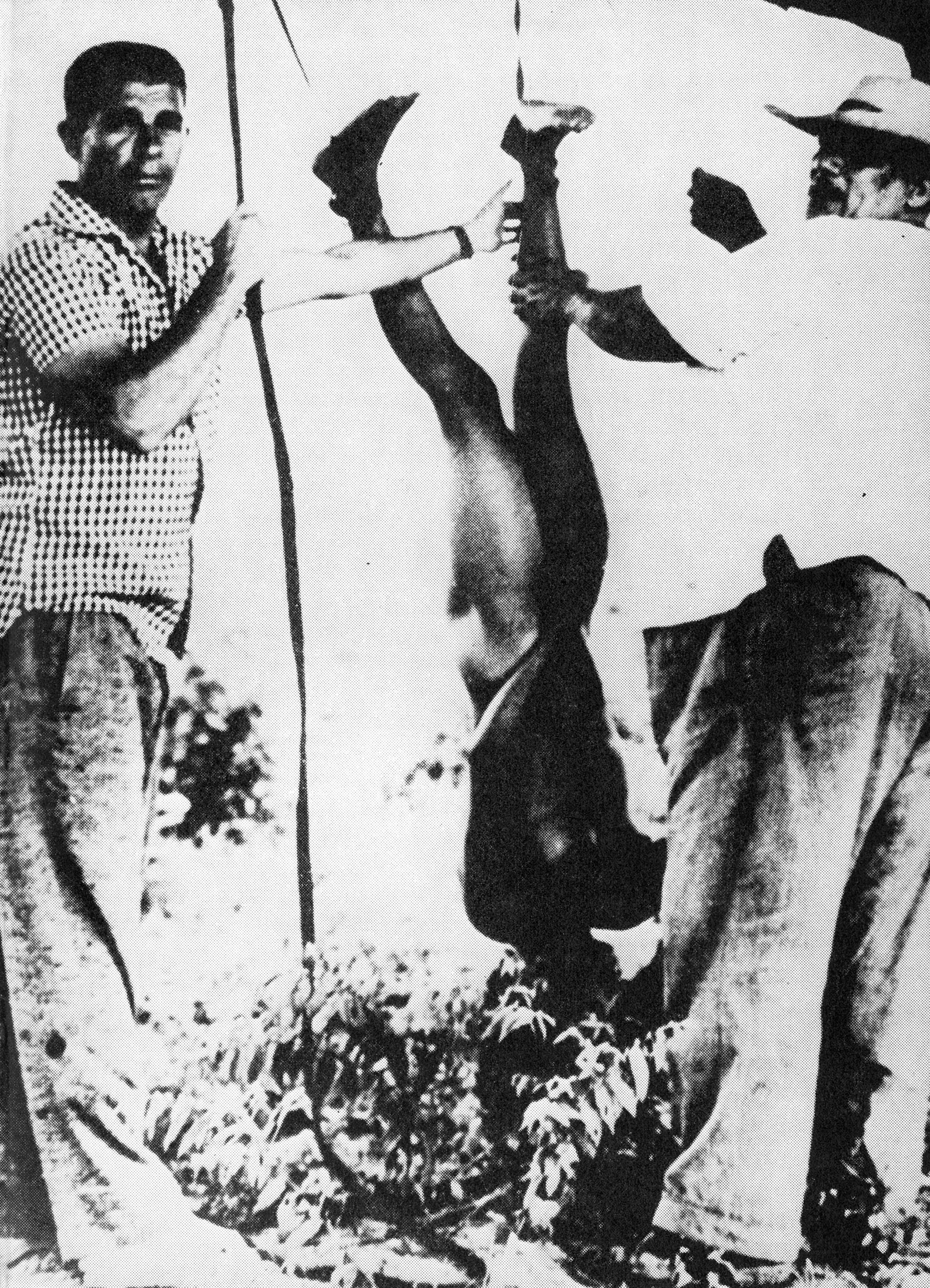 | Atrocities against the Cinta Larga tribe were exposed in the Figueiredo report. After shooting the head off her baby, the killers cut the mother in half. Download hi-res image Credit: © Survival |
IGPA archive"> | A Karajá couple with their baby, who has died of flu. Download hi-res image Credit: © Jesco von Puttkamer/ IGPA archive |
Researchers Discover That The Tulasi Plant Can Be Used To Remove Fluoride From Drinking Water

An exciting and new water treatment breakthrough has been announced that will now make the removal of fluoride from the drinking water supplies of the world’s poorest people more affordable than ever.
Researchers from Rajasthan University in India have discovered that the Tulasi plant, also known as Holy Basil, can be used to significantly reduce the amount of fluoride in drinking water.
At present, the most reliable methods used to remove excessive fluoride from drinking water are either too expensive or not suitable for the environments where they are needed most.
The method discovered by researchers from Rajasthan University is safe, cheap and readily available, making it an ideal alternative for communities who can’t afford to use the more advanced techniques of removing fluoride that are readily available in the West.
An experiment was conducted in the Yellareddyguda village of Narketpally Mandal. The researchers soaked 75mg of Tulasi leaves in 100ml of water that contained 7.4 parts per million of fluoride in the water.
After only soaking the Tulasi leaves for eight hours, it was discovered that the level of fluoride in the water was reduced from 7.4 parts per million, to only 1.1 parts per million.
At present, the World Health Organization recommends that the safe level of fluoride in drinking water is between 0.5 to 1 parts per million.
The dangers of drinking water that contains high levels of fluoride are well known. Some of the known side effects of drinking water that contains fluoride are dental fluorosis, reduced intelligence in children and a damaged nervous system.
This new water treatment option could now provide the world’s poorest people an opportunity to remove excessive fluoride from their drinking water supplies.
However, more research is still needed to identify and validate the effectiveness of using Tulasi leaves as a means of removing fluoride from drinking water supplies.
Considering the cost-prohibitive nature of other more reliable water treatment techniques, if the Tulasi plant is conclusively proven to be effective in removing fluoride from drinking water, then we may witness a revolution in water treatment, providing options to areas where none currently exist.
Source: Activist Post
5 Million Farmers Sue Monsanto for $7.7 Billion
The practice of using renewal seeds dates back to ancient times, but Monsanto seeks to collect massive royalties and put an end to the practice. Why? Because Monsanto owns the very patent to the genetically modified seed, and is charging the farmers not only for the original crops, but the later harvests as well. Eventually, the royalties compound and many farmers begin to struggle with even keeping their farm afloat. It is for this reason that India slammed Monsanto with groundbreaking ‘biopiracy’ charges in an effort to stop Monsanto from ‘patenting life’.
Jane Berwanger, a lawyer for the farmers who went on record regarding the case, told the Associted Press:
“Monsanto gets paid when it sell the seeds. The law gives producers the right to multiply the seeds they buy and nowhere in the world is there a requirement to pay (again). Producers are in effect paying a private tax on production.”
The findings echo what thousands of farmers have experienced in particularly poor nations, where many of the farmers are unable to stand up to Monsanto. Back in 2008, the Daily Mail covered what is known as the ‘GM Genocide’, which is responsible for taking the lives of over 17,683 Indian farmers in 2009 alone. After finding that their harvests were failing and they started to enter economic turmoil, the farmers began ending their own lives — oftentimes drinking the very same insecticide that Monsanto provided them with.
As the information continues to surface on Monsanto’s crimes, further lawsuits will begin to take effect. After it was ousted in January that Monsanto was running illegal ‘slave-like’ working rings, more individuals became aware of just how seriously Monsanto seems to disregard their workers — so why would they care for the health of their consumers? In April, another group of farmers sued Monsanto for ‘knowingly poisoning’ workers and causing ‘devastating birth defects’.
Will endless lawsuits from millions of seriously affected individuals be the end of Monsanto?